
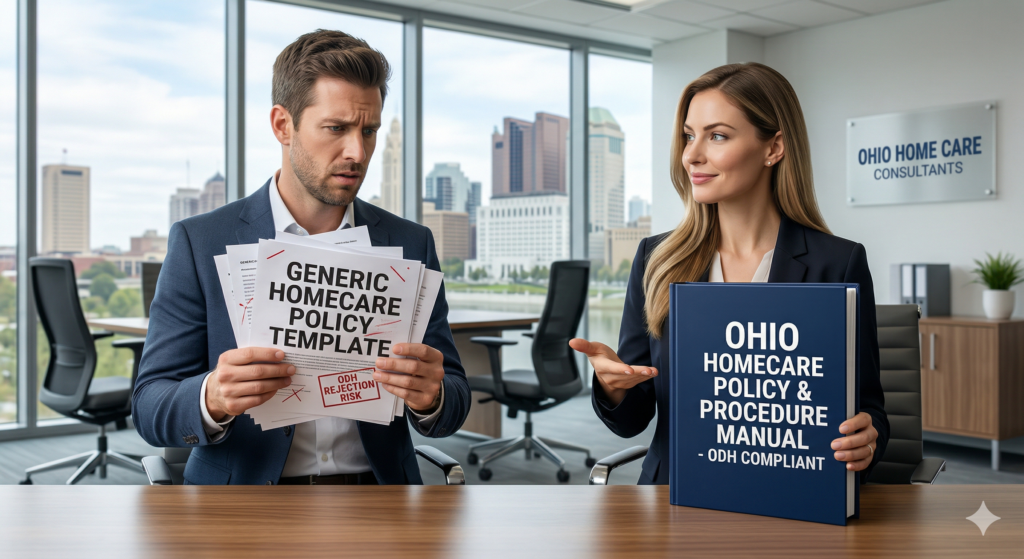
Starting a homecare agency is an exciting venture, but the initial startup phase is filled with complex paperwork and strict regulations. When you are looking at all the costs associated with launching your business, it is incredibly tempting to try and save money by downloading a cheap, fifty-dollar policy manual template online.
However, taking this shortcut can severely jeopardize your new business before it even gets off the ground. The Ohio Department of Health (ODH) has rigorous standards, and using out-of-state or generic templates is a guaranteed way to get your application rejected.
Here is exactly why relying on generic policy manuals is one of the most costly mistakes new homecare owners make in Ohio, and what you should do instead.
The Hidden Danger of “One-Size-Fits-All” Compliance
Homecare regulations are not established at a national level. Every state has its own specific set of laws governing how a homecare or home health agency must operate. A policy manual designed to pass an inspection in Texas or Florida will completely fail to meet the specific requirements mandated by Ohio law.
When an ODH surveyor reviews your application, they are looking for exact compliance with Ohio Administrative Code. If your manual uses generic language or references laws from another state, the reviewer will immediately flag your application. Generic templates simply do not contain the localized legal, administrative, and clinical language required to pass an Ohio Department of Health review.
3 Areas Where Generic Manuals Fail in Ohio
When new owners submit generic paperwork, the state usually finds discrepancies in a few key areas.
1. Emergency Preparedness Plans
Ohio has highly specific requirements for how homecare agencies must handle emergencies, natural disasters, and utility failures. A generic manual might simply state that the agency “will call 911” or “evacuate.” The ODH expects a deeply detailed Emergency Preparedness Plan that outlines exact communication protocols, alternative care strategies, and staff responsibilities during a localized crisis.
2. Infection Control Standards
Infection control is one of the most heavily scrutinized sections of any homecare application. Generic templates often provide basic handwashing guidelines. Ohio reviewers require comprehensive, step-by-step infection control protocols tailored to state mandates, including exposure control plans, biohazard disposal procedures, and personal protective equipment protocols for field staff.
3. Caregiver Onboarding and Human Resources
The way you hire and manage staff must align exactly with Ohio labor laws and ODH background check requirements. Generic manuals frequently miss the specific documentation required for Ohio caregiver onboarding, such as state-mandated criminal background checks, competency evaluations, and specific training timelines. If your HR policies do not reflect Ohio law, your agency will not be approved to operate.
The Domino Effect of an ODH Application Rejection
Submitting non-compliant paperwork carries a heavy consequence for your business timeline and your bottom line.
When the state rejects your generic manual, your entire application gets kicked back to you. This single mistake can delay your opening day by weeks or even months. During this extended waiting period, you are bleeding capital. You are losing potential client revenue while still paying for foundational business costs like office rent, software subscriptions, and commercial insurance.
Furthermore, trying to revise a generic template to meet Ohio standards requires hundreds of hours of frustrating guesswork. You are forced to cross-reference every page of your downloaded template with complex state codes. It becomes a stressful, overwhelming process that pulls your focus away from actually building your business, finding clients, and networking in your community.
What an Ohio-Aligned Manual Actually Looks Like
State reviewers expect to see a comprehensive, highly organized document that proves your agency is ready to operate safely and legally from day one. An Ohio-aligned manual features clearly structured patient rights that match local legislation perfectly.
To pass your ODH review, your documentation must include:
- Customized Client Intake Forms: Professional templates for assessments, care plans, and service agreements that meet state criteria.
- Detailed Quality Assurance Processes: Required documentation structures to prove your agency actively monitors care quality and handles complaints with integrity.
- Accurate Administrative Forms: Staff onboarding checklists, job descriptions, and HR forms built for Ohio employment standards.
These specific documentation structures prove to the state that your agency is professional, compliant, and fully prepared for every operational scenario.
Launch Your Ohio Homecare Agency with Confidence
You do not have to risk a stressful rejection, and you certainly do not need to spend months trying to write complex policies from scratch. You can bypass the guesswork entirely.
The Ohio Homecare Complete Startup Bundle from Ohio Home Care Consultants provides the professionally prepared, state-aligned materials that the Ohio Department of Health expects to see. Our ready-to-use policies cover everything from patient rights to infection control, ensuring your agency documentation perfectly aligns with Ohio regulations.
Stop worrying about application delays. Get your Ohio Homecare Complete Startup Bundle today and move your business forward with total confidence.